
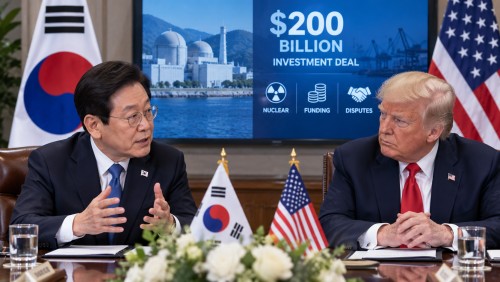
As South Korea and the United States continue to strengthen economic ties, a significant hurdle remains in their discussions over a proposed $200 billion investment by Seoul in the American economy. Central to these ongoing negotiations are unresolved issues concerning nuclear energy projects, funding timelines, and investment risk-sharing, casting uncertainty over the finalization of the agreement.
Nuclear power projects are at the heart of the current discord. The two countries are contemplating the construction of eight nuclear reactors in the United States, with differing preferences for reactor designs. While South Korea is committed to involving its APR1400 technology in two of these reactors, the U.S. side, along with Westinghouse, favors the exclusive use of Westinghouse’s AP1000 design. This disagreement has complicated discussions on the nuclear component of South Korea’s investment, which could reach $120 billion.
Further complicating matters is South Korea’s interest in acquiring a stake in Westinghouse, seeking a 15% to 20% share along with voting rights and a board seat. In contrast, Westinghouse is pushing to limit South Korean ownership to less than 10%. This ownership debate underscores the broader tensions over control and influence in the proposed nuclear ventures.
Beyond nuclear energy, the investment talks also touch on South Korea’s potential role in a U.S. project for processing spent nuclear fuel and participation in a proposed liquefied natural gas project in Alaska. Concerns about the financial viability and construction costs of these ventures add another layer of complexity to the negotiations.
Funding schedules and financial risk-sharing are additional sticking points. The United States has requested over $9 billion from South Korea by the end of the year, a timeline that contrasts with Seoul’s preference to defer substantial financial contributions until 2026. Additionally, South Korea advocates for a system where profits from successful projects offset losses from others, while the U.S. strategy emphasizes project-specific accounting.
The proposed framework would see the U.S. claiming 90% of net profits post-recovery of principal and interest. South Korea fears this could lead to imbalanced returns, with the U.S. benefiting from profitable projects while Seoul absorbs losses from unsuccessful ones. Despite these challenges, both governments remain engaged in dialogue, with South Korea’s Industry Ministry underscoring that no final decisions have been made regarding the investment’s scope and structure.