
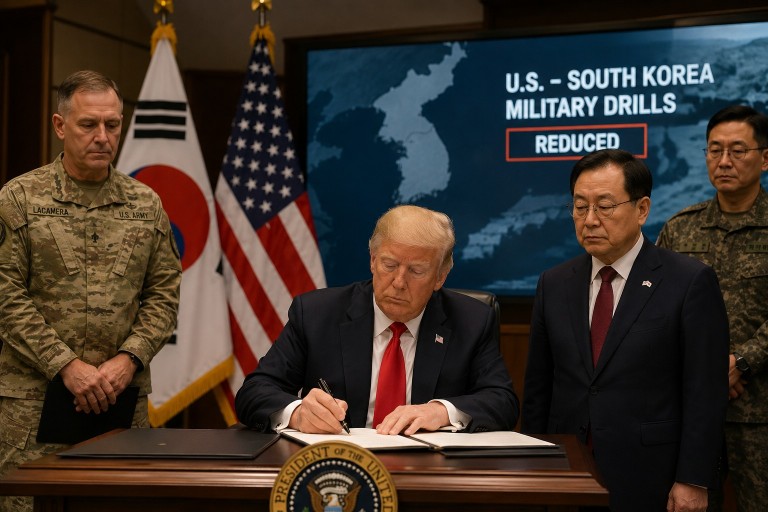
President Donald Trump has announced a significant reduction in the joint military exercises conducted with South Korea, citing the financial burden and the potentially counterproductive message it sends to North Korea. Trump attributes the move to his favorable rapport with North Korean leader Kim Jong-un. The Ulchi Freedom Shield exercises, set to commence on Monday and run through August 27, were to involve approximately 18,000 South Korean soldiers alongside U.S. forces and personnel from various United Nations Command member nations.
Although Trump mentioned it was too late to completely cancel the drills, he has directed Defense Secretary Pete Hegseth to notably reduce the U.S. involvement. Despite Trump’s directive, South Korea’s defense ministry has stated that the exercises will proceed as originally planned. This decision comes amid growing concerns from U.S. and South Korean military officials over North Korea’s increasing battlefield experience, gained through its military support to Russia in the ongoing conflict in Ukraine. North Korea has reportedly dispatched over 14,000 troops to bolster Russian forces, contributing artillery ammunition and ballistic missiles as well.
Military officials have noted that North Korean troops are acquiring firsthand experience with advanced warfare technologies such as drones, GPS disruption, cyber operations, and missile systems. In response, U.S. military officials have modified the exercises to confront these evolving threats. There is apprehension that the expertise North Korean forces gain while in Ukraine could enhance Pyongyang’s military capabilities upon their return.
This is not the first time President Trump has scaled back or suspended major U.S.-South Korean military exercises as part of his diplomatic engagements with Kim. His latest decision has sparked renewed concerns in Seoul regarding the stability of the U.S.-South Korea alliance and the region’s deterrence posture. South Korean analysts caution that reducing the exercises might diminish military readiness and deterrence, offering limited diplomatic advantages since North Korea traditionally demands the complete termination of such drills.
North Korea has consistently denounced the exercises as rehearsals for an aggressive war, threatening to retaliate with enhanced military actions. In a show of defiance, Pyongyang has also conducted ballistic missile tests in anticipation of the drills. Despite Trump’s decision to scale back, South Korean officials underscore the crucial role these joint exercises play in maintaining preparedness against a progressively formidable North Korean military.