
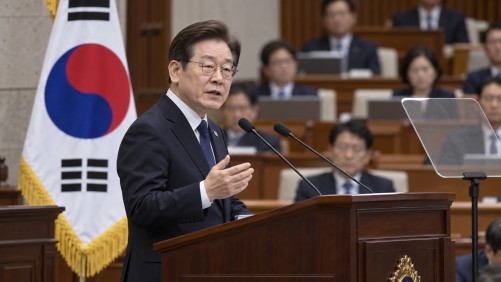
In a call for constitutional reform, South Korean President Lee Jae Myung has urged the formal recognition of the nation’s pro-democracy movements, highlighting the importance of preserving historical legacies. During a ceremony in Busan on Friday, commemorating the 47th anniversary of the 1979 Buma uprising, President Lee addressed the National Assembly, advocating for discussions on constitutional amendments. He emphasized that acknowledging these pivotal movements in the Constitution’s preamble would honor those who bravely fought against authoritarianism.
The Buma uprising, which began on October 16, 1979, at Pusan National University, marked a significant moment in South Korea’s transition to democracy. Protesters in Busan and Masan challenged the authoritarian regime of then-President Park Chung-hee, facing a harsh crackdown that included arrests and martial law. Lee argued that recognizing this and other movements, such as the May 1980 Gwangju Democratization Movement and the June 1987 Democracy Movement, would reinforce the principle that political power should remain accountable to the people.
President Lee’s call for reform is not new; he has consistently advocated for constitutional changes, including a shift from the current single five-year presidential term to a two consecutive four-year term system. Despite a previous amendment proposal by the ruling Democratic Party of Korea failing in May, Lee believes that acknowledging the nation’s democratic struggles could serve as common ground for renewed discussions.
During his speech, Lee paid tribute to the protesters who risked their lives in defense of democracy, underscoring their actions as vital milestones in South Korea’s democratic development. He also emphasized the need for future generations to inherit a democracy that does not require sacrifices to be protected.
Lee’s proposal seeks to initiate public consultations and collaborative efforts from lawmakers across political lines, aiming for meaningful constitutional reform. By embedding these historical movements in the national Constitution, Lee hopes to preserve their legacy and instill the values of democracy and popular sovereignty in future generations.