
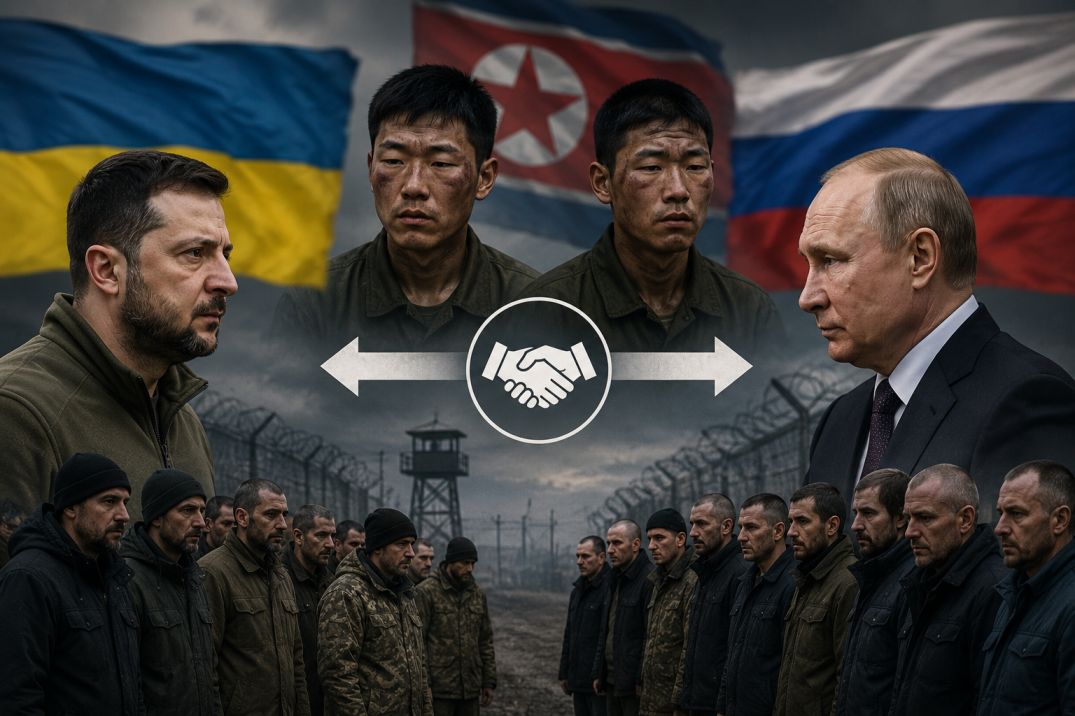
Amid ongoing diplomatic discussions, Ukraine faces a complex dilemma following reports that Russia has proposed a significant prisoner exchange involving Ukrainian prisoners of war and two North Korean soldiers captured by Ukraine. This potential exchange, suggested during Ukrainian Foreign Minister Andrii Sybiha’s visit to South Korea, could impact the future of the North Korean soldiers who have expressed a desire to settle in South Korea. While the magnitude of Russia’s purported offer has been met with skepticism by several diplomatic insiders, the proposition underscores the challenging humanitarian and political decisions confronting Ukraine.
During Sybiha’s visit to Seoul, he engaged with South Korean Foreign Minister Cho Hyun and participated in policy discussions at the Asan Institute for Policy Studies. It was here that Sybiha reportedly revealed Russia’s suggestion to return the North Korean soldiers to Pyongyang in exchange for thousands of Ukrainians held by Russia. These remarks seem to focus more on the intricate political landscape Kyiv navigates rather than indicating any formal negotiation process underway.
South Korea has reiterated its readiness to welcome the two North Korean soldiers, should they choose to resettle voluntarily, in line with its constitutional view of North Koreans as citizens. Ukrainian authorities have assured that they will not force the soldiers back to North Korea against their wishes, yet a definitive resolution has not been reached. This situation highlights Ukraine’s efforts to weigh humanitarian concerns against the imperative to secure the release of its citizens from Russian detention.
In addition to the prisoner exchange discussions, talks between South Korea and Ukraine have expanded to consider South Korea’s involvement in Ukraine’s postwar reconstruction. Ukraine is keen on South Korean assistance in rebuilding critical infrastructure and energy sectors once the conflict concludes. However, South Korea maintains that cooperation on humanitarian issues, such as the fate of the prisoners of war, remains distinct from broader reconstruction efforts or aid.
The uncertainty surrounding the two North Korean soldiers, captured in Russia’s Kursk region in January 2025, persists as both governments deliberate within the framework of international law and humanitarian principles. Their capture marks a notable event as the first publicized case of North Korean troops being taken alive after their deployment in support of Russia’s military operations. As these diplomatic conversations progress, the situation remains a sensitive issue intertwining humanitarian duties, prisoner exchange dynamics, and regional security considerations.